Kew monograph 02: More Kew specimens from Nina’s product pages
Abstract
We build on the monograph of the Kew dresses with additional descriptions for the Kew dress specimens on Nina Lee’s product pages; including the first skirt species description in the entire taxonomy, Kewisicasa laria. In total, we describe 21 new species and six new subgenera; and populate the genus Kewisicasa with new specimens.
Keywords
kew dress, kewoidea, kewthidae, helikewidae, nina lee, clothing taxonomy, home sewing, sewing pattern
1 Background
The Kew dress is now perhaps the most extensively-studied sewing pattern in the LCT-01. Earlier in March 2026, we published a 52-page monograph on the Kew dresses, which laid out the structure of Kew dress taxonomy and described over 47 species [1].
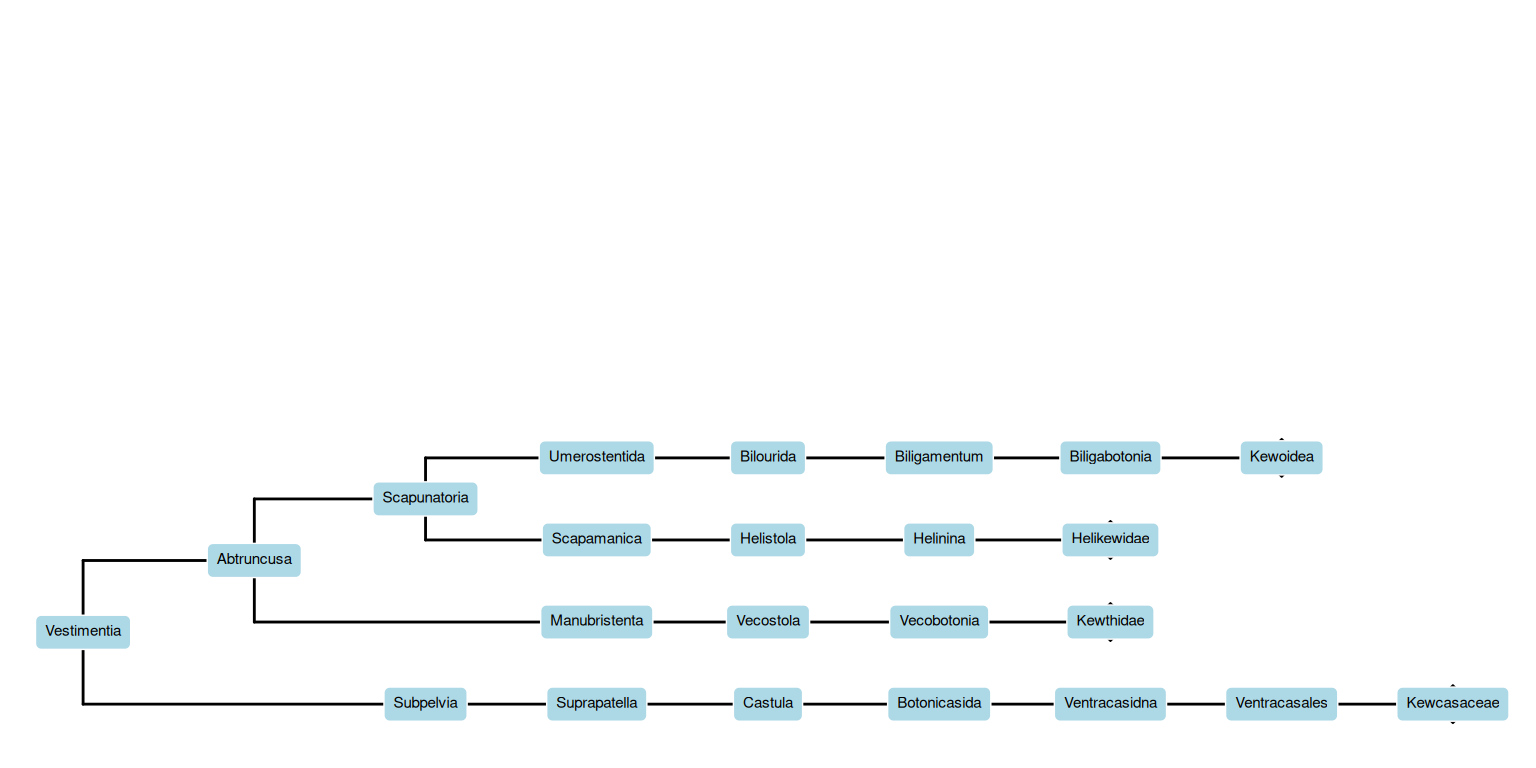
The total count of Kew dress taxa now stands at 1 superfamily (Kewoidea); 5 families (Kewidae, Plesikewidae, Helikewidae, Kewthidae, and Kewcasaceae); 6 subfamilies (Kewbellinae, Kewthinae, Trunkewinae, Helikewinae, Plesikewinae, and Kewasalinae); 2 tribes (Helikewini, Helikewbellini, Kewthini); 19 genera (Kewplicasa, Kewparacasa, Kewisicasa, Kewbellothea, Kewpepla, Kewthea, Kewthicata, Trunkewia, Helikewbellia, Helikewparabola, Helikewplicata, Helikewabotonia, Helikewisia, Kewasalia, Florankewia, Kewabotonia, Kewplicata, Kewparabola, Kewisia); 8 subgenera; and 67 species.
Size is typically not considered a relevant morphological character for taxa due to its continuous, non-discrete nature. However, the sale of size ranges of sewing patterns as separate products constitutes discrete phylogenetic information, which is best suited for defining infrageneric taxa. The usage of infrageneric ranks originated in Heleonora Lemuria, 2026 (unpublished so far), encompassing the sleeveless variant of the Eleonora by Silversaga Patterns.
1.1 Taxonomic history
The large amount of Kew dresses on the Internet threatened to inflate the scope of [1] excessively; as such, we enacted a “species freeze” where new Kew specimens would be reserved for subsequent papers. We continue our research into the Kew dress as part of this paper, describing 21 new species, six new subgenera, and one new genus, Kewisicasa.
When authoring the Kew monograph, we focused primarily on makes of the pattern in the wild as opposed to official product photos, for a variety of reasons, such as not wanting to have the appearance of a reseller catalog1, and the anecdotal observation that third parties produce richer documentation than official product pages.
Originally, we were unable to identify the wearers of each holotype specimen beyond their first name. However, on April 3, our lead author decided to include a history of how Chang-Smith developed the expanded size ranges, and in the process, decided also to cite posts by Chang-Smith featuring many of the holotypes on Instagram that included information on the persons featured. Though not every single person was identifiable due to broken Instagram links or Imginn not having the requested profile, we were able to further confirm some identities by correlating them with filenames from the Nina Lee website.
Timestamps were also updated based on these posts; we inferred the old timestamps from the v variable on Shopify CDN images, which likely do not reflect the image’s actual creation date.
1.2 Terminology
The term “expansion” is rather ambiguous in this context, as it can either refer to the Kew dress expansion pack, which adds two skirt options, or to the expanded size range.
Thus, we use four standardized terms for the four Kew patterns.
- Kew 6-20 refers to the “base” Kew pattern, from UK sizes 6 to 20.
- Kew 16-28 refers to the “base” Kew pattern, from UK sizes 16 to 28.
- Kew expansion 6-20 refers to the expansion pack, from UK sizes 6 to 20.
- Kew expansion 16-28 refers to the expansion pack, from UK sizes 16 to 28.
1.3 History of the expansion
The Kew dress’s history is extensively discussed in [1]. Here, we focus on Nina Chang-Smith’s expansion of her size range to UK size 28.
The first public evidence that Chang-Smith was working on the expansion came in October 2019, when she posted an advertisement looking for a UK size 20 fit model to review her adjusted base size with, before grading. In the advertisement, Chang-Smith specified a model with a bust of ~116 cm (46 in), waist of ~98 cm (39 in), and hip of ~124 cm (49 in)2 [2].
Chang-Smith worked on her expanded ranges in reverse-chronological pattern release order; recruiting testers for the Southbank, Carnaby, and Mayfair in January 2020 [3]; and later in September, the Kew [4]. On February 19, 2021, the Kew 16-28 pattern was released.
2 Methods
The lead author conducted his research on a computer running Ubuntu 24.04, with the XFCE desktop environment. He used the SHA2-256 algorithms to compute the cryptographic hashes of the photographic specimens he examined for species descriptions. He used Firefox 139.0.4. His monitor is a 55.8 cm (22 in) wide, 30.48 cm (12 in) tall, 63.5 cm (25 in) diagonal monitor, the NVISION S2515-B 25” IPS with a 100Hz refresh rate. He is not colorblind. He is near sighted and wears glasses.
As our lead author had no Instagram account, he used Imginn, an online service that allows Instagram to be viewed without an account.
Specimens were collected from Nina Lee’s product pages on https://ninalee.co.uk. All images were in JPG format. The website uses Shopify as its underlying platform and image storage; EXIF metadata is scarce, and this removal is likely consistent with internal Shopify server-side upload processing code. EXIF metadata was checke d using ExifTool version 12.76.
2.1 lct01-notes
During work on this paper, the author created a new tool that automatically generates Quarto template text from structured YAML data. This allows the data to exist in a structured format for future processing with other systems, and further improves standardization. Descriptions and remarks remain human-written; with less administrative and menial work comes the opportunity for more creative work.
A paper dedicated solely to this software has not been started, but may be authored someday. The tool was developed during the creation of this paper; as such, not all entries were automatically templated. YAML files used to generate some of the template texts are provided with the paper.
2.2 Checksums
The versions of the sha256sum and openssl utilities on his system at the time of the paper are given in the below terminal output:
$ sha256sum --version
sha256sum (GNU coreutils) 9.4
Copyright (C) 2023 Free Software Foundation, Inc.
License GPLv3+: GNU GPL version 3 or later <https://gnu.org/licenses/gpl.html>.
This is free software: you are free to change and redistribute it.
There is NO WARRANTY, to the extent permitted by law.

Written by Ulrich Drepper, Scott Miller, and David Madore.
$ openssl --version
OpenSSL 3.5.0 8 Apr 2025 (Library: OpenSSL 3.5.0 8 Apr 2025)
$ sha256sum /usr/bin/sha256sum /usr/bin/openssl
f293048f656688883ee919eb3f4b12926aaa13362de0eb6e3b5716b915b18b35  /usr/bin/sha256sum
724acbe911513d13f52bae0b8969b20336cd8618fc67898a6bf7847bf1a270ad /usr/bin/openssl3 Trees
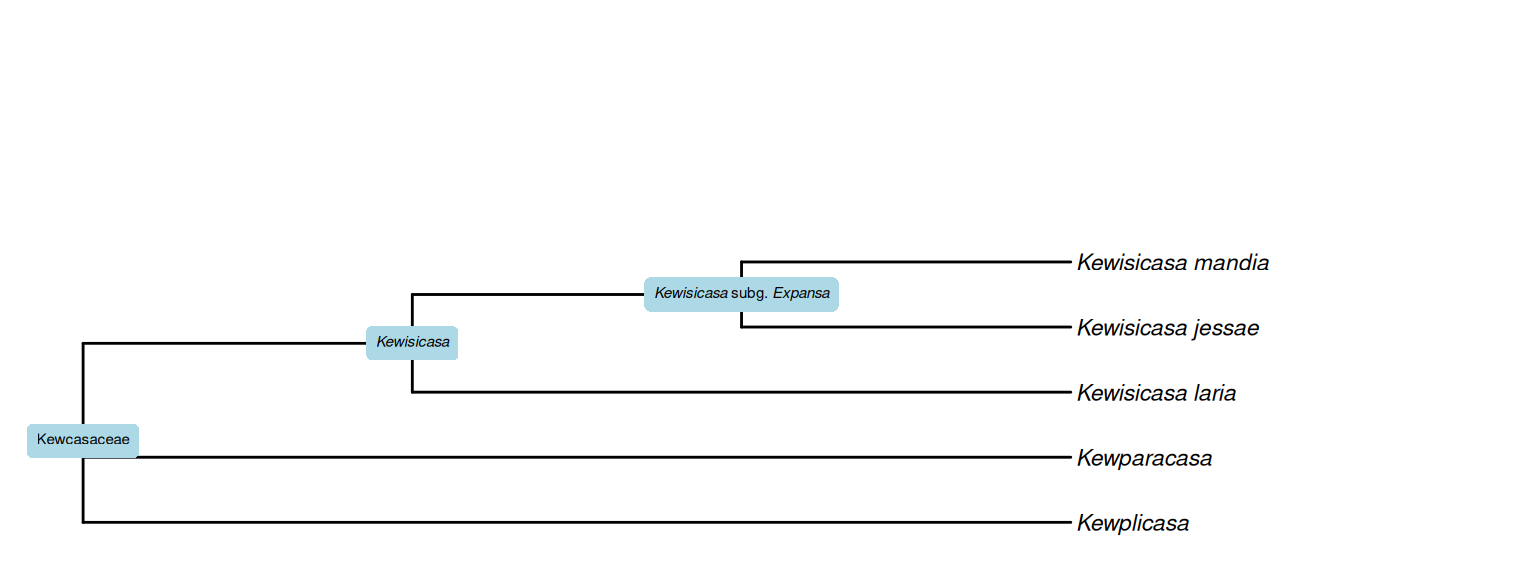
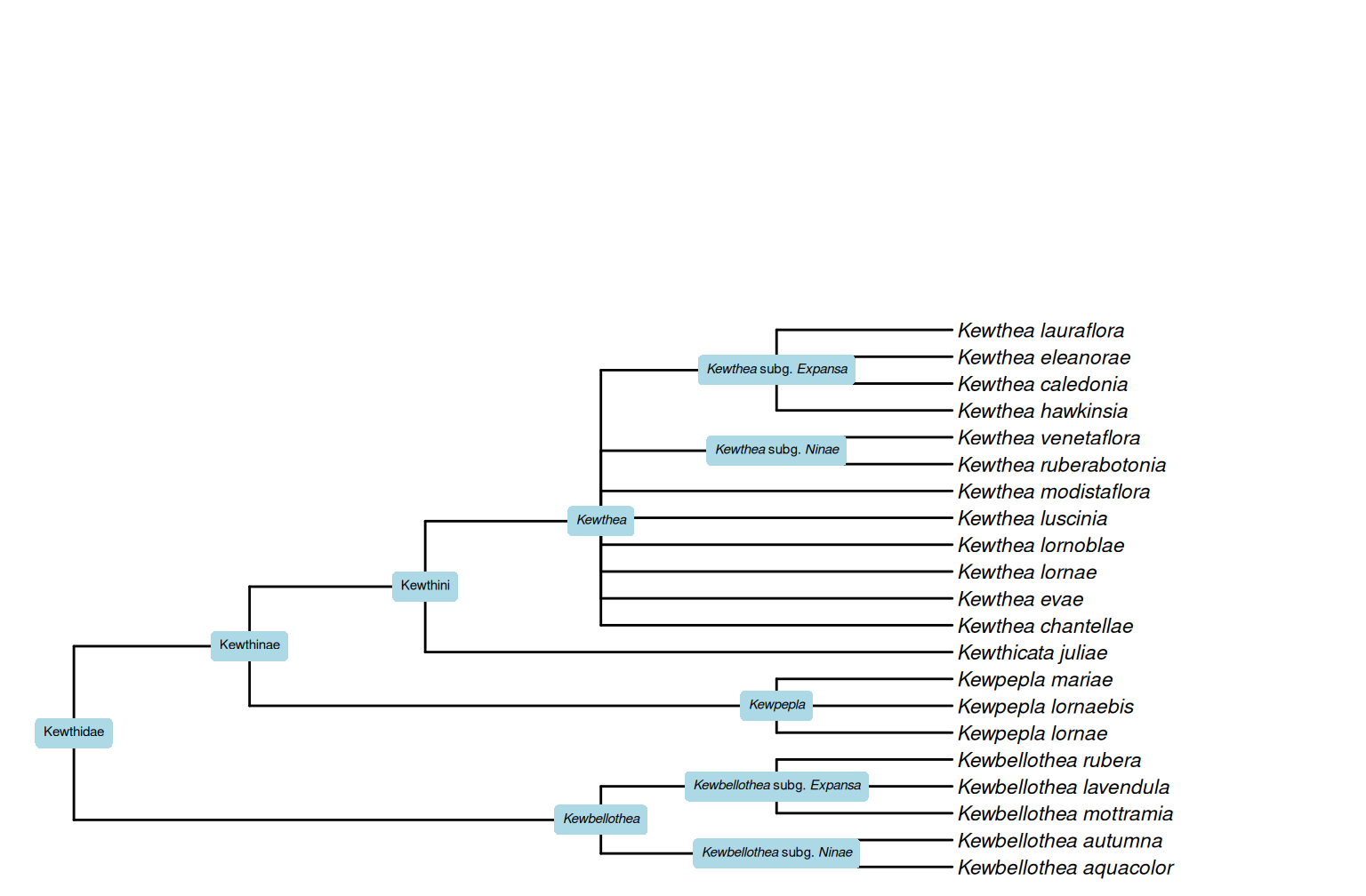
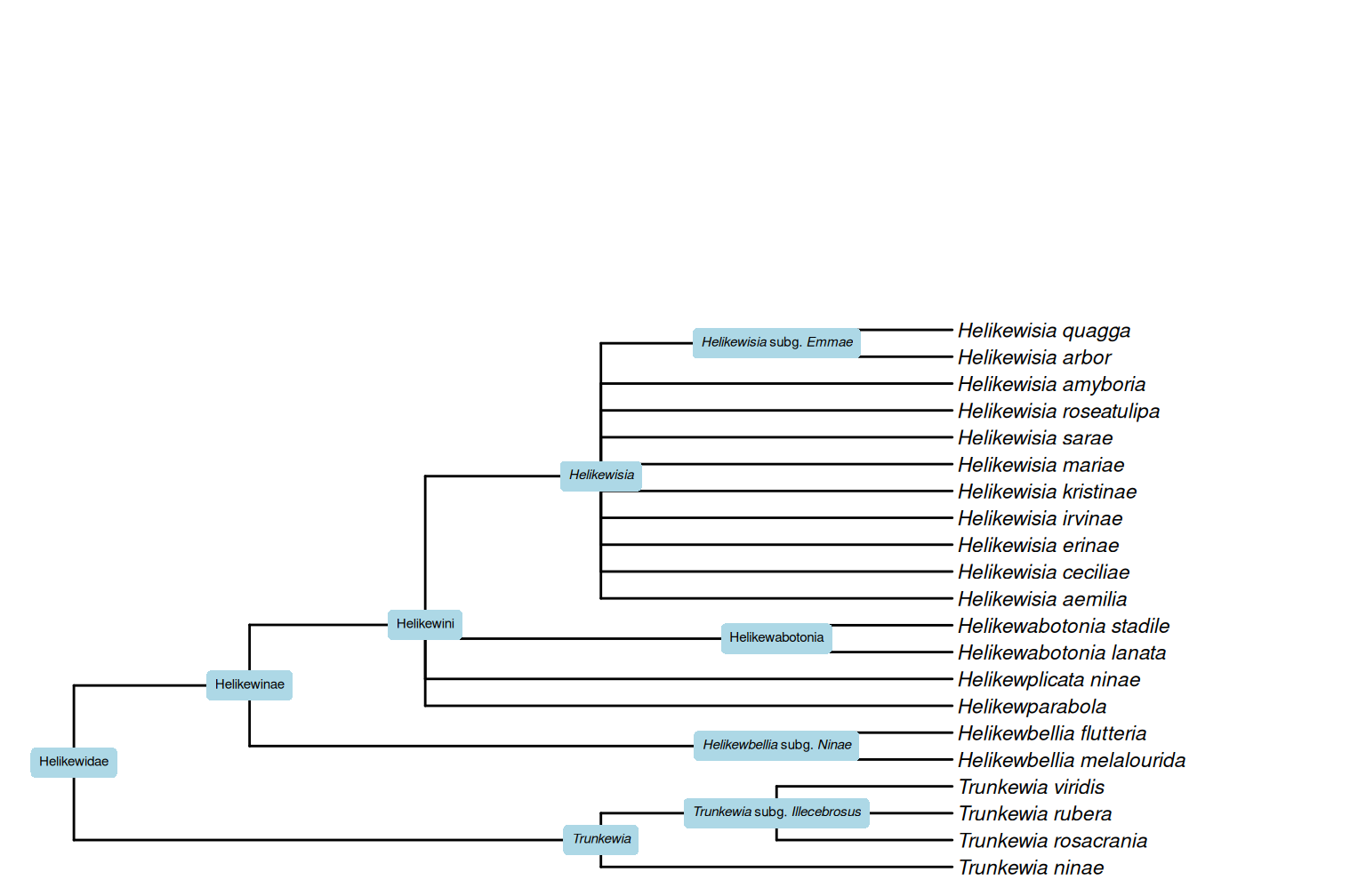
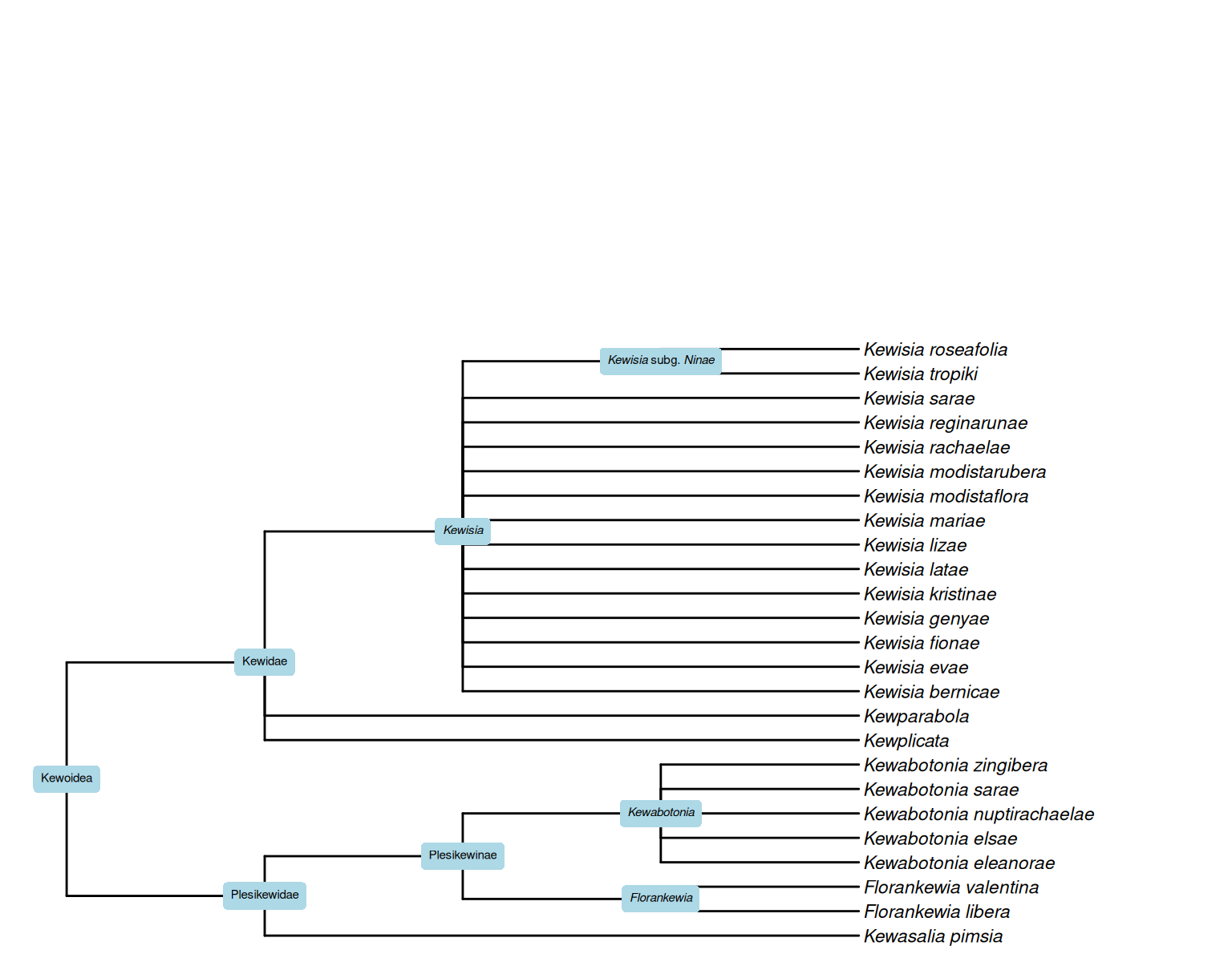
As previously stated in [1], the hybrid phenetic–phylogenetic structure of the LCT-01 causes the Kew dresses to scatter polyphyletically across the tree. The updated Kew trees are presented below.
library(treeio)
library(ggtree)
library(ggplot2)
library(ggtreeExtra)
library(dplyr)
library(ggtext)
library(knitr)

text <- "((((((((Kewplicasa,Kewparacasa,(Kewisicasa_laria,(Kewisicasa_jessae,Kewisicasa_mandia)Kewisicasa_subg._Expansa)Kewisicasa[&&NHX:rank=genus])Kewcasaceae[&&NHX:subtree_root=yes])Ventracasales)Ventracasidna)Botonicasida)Castula)Suprapatella)Subpelvia,((((((((Kewbellothea_mottramia,Kewbellothea_lavendula,Kewbellothea_rubera)Kewbellothea_subg._Expansa,(Kewbellothea_aquacolor,Kewbellothea_autumna)Kewbellothea_subg._Ninae)Kewbellothea[&&NHX:rank=genus])Kewbellinae,((Kewpepla_lornae,Kewpepla_lornaebis,Kewpepla_mariae)Kewpepla[&&NHX:rank=genus],((Kewthicata_juliae)Kewthicata[&&NHX:rank=genus],(Kewthea_chantellae,Kewthea_evae,Kewthea_lornae,Kewthea_lornoblae,Kewthea_luscinia,Kewthea_modistaflora,(Kewthea_ruberabotonia,Kewthea_venetaflora)Kewthea_subg._Ninae,(Kewthea_hawkinsia,Kewthea_caledonia,Kewthea_eleanorae,Kewthea_lauraflora)Kewthea_subg._Expansa)Kewthea[&&NHX:rank=genus])Kewthini)Kewthinae)Kewthidae[&&NHX:subtree_root=yes])Vecobotonia)Vecostola)Manubristenta,(((((((Trunkewia_ninae,(Trunkewia_rosacrania,Trunkewia_rubera,Trunkewia_viridis)Trunkewia_subg._Illecebrosus)Trunkewia[&&NHX:rank=genus])Trunkewinae,((((Helikewbellia_melalourida,Helikewbellia_flutteria)Helikewbellia_subg._Ninae)Helikewbellia[&&NHX:rank=genus])Helikewbellini,(Helikewparabola,(Helikewplicata_ninae)Helikewplicata[&&NHX:rank=genus],(Helikewabotonia_lanata,Helikewabotonia_stadile)Helikewabotonia,(Helikewisia_aemilia,Helikewisia_ceciliae,Helikewisia_erinae,Helikewisia_irvinae,Helikewisia_kristinae,Helikewisia_mariae,Helikewisia_sarae,Helikewisia_roseatulipa,Helikewisia_amyboria,(Helikewisia_arbor,Helikewisia_quagga)Helikewisia_subg._Emmae)Helikewisia[&&NHX:rank=genus])Helikewini)Helikewinae)Helikewidae[&&NHX:subtree_root=yes])Helinina)Helistola)Scapamanica,((((((((Kewasalia_pimsia)Kewasalia[&&NHX:rank=genus])Kewasalinae,((Florankewia_libera,Florankewia_valentina)Florankewia[&&NHX:rank=genus],(Kewabotonia_eleanorae,Kewabotonia_elsae,Kewabotonia_nuptirachaelae,Kewabotonia_sarae,Kewabotonia_zingibera)Kewabotonia[&&NHX:rank=genus])Plesikewinae)Plesikewidae,(Kewplicata[&&NHX:rank=genus],Kewparabola[&&NHX:rank=genus],(Kewisia_bernicae,Kewisia_evae,Kewisia_fionae,Kewisia_genyae,Kewisia_kristinae,Kewisia_latae,Kewisia_lizae,Kewisia_mariae,Kewisia_modistaflora,Kewisia_modistarubera,Kewisia_rachaelae,Kewisia_reginarunae,Kewisia_sarae,(Kewisia_tropiki,Kewisia_roseafolia)Kewisia_subg._Ninae)Kewisia[&&NHX:rank=genus])Kewidae)Kewoidea[&&NHX:subtree_root=yes])Biligabotonia)Biligamentum)Bilourida)Umerostentida)Scapunatoria)Abtruncusa)Vestimentia;"

tree <- read.nhx(textConnection(text))

subtree_nodes <- tree@data %>%
  filter(subtree_root == "yes") %>%
  pull(node)

p <- ggtree(tree)

for (n in subtree_nodes) p <- collapse(p, n) + geom_point2(aes(subset=(node==!!n)), shape = 23, size=5, fill='red')

rootTree <- p + geom_tiplab(size = 3) +
  geom_richtext(
    aes(label = label),
    data = td_filter(!isTip),
    size = 2, na.rm = TRUE,
    fill = 'lightblue', label.color = 'white'
  ) + vexpand(1)

fig_height <- function(tr) max(3, min(length(tr@phylo$tip.label) * 0.25, 12))

plots <- list(
  list(p = rootTree, w = 12, h = 4, label = "Overview")
)

format_node_label <- function(label, rank) {
  if (!is.na(rank) && rank == "genus") {
    return(paste0("<i>", gsub("_", " ", label), "</i>"))
  }
  components <- unlist(strsplit(label, "_"))
  if (grepl("subg\\.", label)) {
    new_label <- paste0("<i>",components[1],"</i> subg. <i>",components[3],"</i>")
    return(new_label)
  }
  paste0(gsub("_", " ", label))
}

format_species <- function(label) {
  paste0(gsub("_", " ", label))
}

for (n in subtree_nodes) {
  subtree <- tidytree::tree_subset(tree, n, levels_back = 0)
  if (length(subtree@phylo$tip.label) < 2) next

  root_taxon_node <- as_tibble(tree) |> filter(node == n)
  root_taxon <- root_taxon_node |> pull(label)
  p_sub <- ggtree(subtree) +
    geom_tiplab(size = 3, aes(label = mapply(format_species, label)), fontface = "italic") +
    geom_richtext(
      data = td_filter(!isTip),
      aes(label = mapply(format_node_label, label, rank)),
      size = 2, na.rm = TRUE,
      fill = 'lightblue', label.color = NA
    ) +
    hexpand(0.3) + vexpand(0.5)
  plots[[length(plots) + 1]] <- list(p = p_sub, w = 12, h = fig_height(subtree), label = root_taxon)
}

for (i in seq_along(plots)) {
  p <- plots[[i]]
  chunk <- knitr::knit_expand(
    text = c(
      "```{r fig-{{label}}, fig.height={{h}}, fig.width=8, fig.cap='{{label}}', echo=FALSE}",
      "plots[[{{i}}]]$p",
      "```"
    ),
    i = i,
    h = plots[[i]]$h,
    label = plots[[i]]$label
  )
  cat(knitr::knit(text = chunk, quiet = TRUE))
  cat("\n\n")
}
4 Descriptions
4.1 Genus Helikewbellia
Helikewbellia Lemuria, 2026; first public desc.
Diagnosis: Phylogenetically, Helikewbellia is characterized by origin from the sleeveless variant of the Kewbello pattern; phenetically, the combination of the Kew sleeveless strappy bodice and Portobello trousers; and the presence of a dorsal medial zipper on the bodice. Bilateral ventral darts present from the third button to the bodice–skirt seam; bilateral sets of three seams at outward flare angle; bilateral pockets.
Remarks: There exist two phylogenetic pathways through which a sleeveless Kewbello may arise; from the Kewbello pattern itself (pathway 1), or an independent recombination of the Kew sleeveless dress bodice and the Portobello trousers, done without referencing the pattern (pathway 2). Pathway 2 remains unattested.
Type species: Helikewbellia flutteria (see Section 4.2.2)
4.2 Helikewbellia subg. Ninae
Helikewbellia subgenus Ninae Lemuria, 2026
Diagnosis: Phylogenetically, Helikewbellia subg. Ninae is defined by having been created by Nina Chang-Smith.
Etymology: Nina + -ae.
Type species: Helikewbellia flutteria (see Section 4.2.2)
4.2.1 Helikewbellia melalourida
Helikewbellia melalourida Lemuria, 2026
Holotype: Nina 90381.248 — Photograph. EXIF metadata stripped. Helikewbellia melalourida wb. Nina, unknown. Angled ventral view. Subject’s arms fully adducted, in pockets; ventral medial button row blends into fabric, visibility impeded. © Nina Chang-Smith or unknown photographer, all rights reserved.
- Page: [5]
- SHA2-256:
00d5f66d76582d50e753f55b5b7d5c4f197703d159a0777293de27349064418c - Raw image URLs


Diagnosis: Helikewbellia melalourida is characterized by a fabric with a black background, with white line drawings of houses and palm trees, consistent with upper-class coastal California communities.
Remarks: The description of the fabric as being similar to upper-class coastal California communities may be influenced by the lead author’s knowledge that as of 2026, Nina Chang-Smith has lived in California since 2022.
Etymology: From Latin melas (“black”) + Greek λουρίδα (lourída, “strap”), referring to the black color of the straps.
Specimens examined:
- Holotype.
- Nina 90381.276 — Photograph. EXIF metadata stripped. Dorsal view. Hair positioned ventrally. Helikewbellia melalourida wb. Nina, unknown. © Nina Chang-Smith or unknown photographer, all rights reserved.
- Page: [5]
- SHA2-256:
22c2db3b17bd839650280e8f4e51a98d75da5021d20c9c5358adc37894a36fa5 - Raw image URLs


4.2.2 Helikewbellia flutteria
Helikewbellia flutteria Lemuria, 2026
Holotype: Nina 90387.475 — Photograph. EXIF metadata stripped. Helikewbellia flutteria wb. Nina, unknown. © Nina Chang-Smith or unknown photographer, all rights reserved.
- Page: [5]
- SHA2-256:
c9483d4b827b26e3f9cd41c381380dbe04ca28b2e8ba2ef41ea097d768242c2e - Raw image URLs


Diagnosis: Helikewbellia flutteria is characterized by a flutter sleeve, with fabric attached to the lateral sides of the straps; and a fabric with a vague watercolor floral pattern, with a yellow background, with smaller amounts of pale orange and olive green color; and a ventral medial button row of five circular buttons with an interior curved square and four thread holes; and yellow thread.
Remarks: The classification of Helikewbellia flutteria may be a useful example in the eventual classification of Lauren Johnson’s flutter Kew dress.
Etymology: From English flutter, a word of Germanic origin + -ia, for a Latin feel.
Specimens examined:
- Holotype.
- Nina 90387.478 — Photograph. EXIF metadata stripped. Helikewbellia flutteria wb. Nina, unknown. © Nina Chang-Smith or unknown photographer, all rights reserved.
- Page:
- SHA2-256:
87425f5d907e3c01382b563e6e276bd506e838159014d2973a6b9d8fb3e79391 - Raw image URLs


4.3 Genus Helikewisia
Helikewisia Lemuria, 2026
See [1].
4.3.1 Helikewisia roseatulipa
Helikewisia roseatulipa Lemuria, 2026; sp. nov.
Holotype: Kew 74024.100HR — Photograph. 2067×2835. EXIF metadata stripped. Ventral view. Hair positioned dorsally. Helikewisia roseatulipa wb. Amy.C., 2017. © Nina Chang-Smith or unknown photographer, 2017, all rights reserved.
- Page: See [6]
- SHA2-256:
b27c74a092a9222518bb154f79468dd3caa0dd7f894dcdfd3730113885008202 - Raw image URLs:


Diagnosis: Helikewisia roseatulipa is characterized by its fabric pattern of pink tulips and green leaves against a white background and its ventral medial row of 15 shank button with no thread holes, with a wood-like surface.
Etymology: Portmanteau of Latin rosea, feminine form of roseus (“pink”) + Tulipa L.
Specimens examined: See holotype information.
4.3.2 Helikewisia amyboria
Helikewisia amyboria Lemuria, 2026; sp. nov.
Holotype: Kew 9018.1728, person on left. See Section 6.2.
Diagnosis: Helikewisia amyboria is characterized by its fabric pattern of trees with pink trunks and slight potato/brown/golden-colored leaves, and clouds and a ventral medial row of 15 circular buttons with four thread holes.
Etymology: Blend of Amy + Latin arbor (“tree”), as Helikewisia arbor is already used.
Specimens examined: See holotype information.
4.4 Genus Kewbellothea
Kewbellothea Lemuria, 2026; first public desc.
Diagnosis: Phylogenetically, Kewbellothea is characterized by origin from the sleeved variant of the Kewbello pattern; phenetically, the combination of the Kew tea dress bodice and Portobello trousers; and the presence of a dorsal medial zipper on the bodice. Bilateral ventral darts present from the third button to the bodice–skirt seam; bilateral sets of three seams at outward flare angle; bilateral pockets.
Remarks: There exist two phylogenetic pathways through which a tea dress Kewbello may arise; from the Kewbello pattern itself (pathway 1), or an independent recombination of the Kew tea dress bodice and the Portobello trousers, done without referencing the pattern (pathway 2). Pathway 2 remains unattested.
Type species: Kewbellothea aquacolor (see Section 4.6.1)
4.5 Kewbellothea subg. Expansa
Kewbellothea subgenus Expansa Lemuria, 2026; subgen. nov.
Diagnosis: Phylogenetically, Kewbellothea subg. Expansa is defined by origin from size 21 and above of the Kewbello pattern. See [7].
Etymology: From Latin expansa, feminine form of expansus (“expanded”), referring to the pattern’s expanded size range..
Type species: Kewbellothea mottramia (see Section 4.5.1)
4.5.1 Kewbellothea mottramia
Kewbellothea mottramia Lemuria, 2026; sp. nov.
Holotype: Mottram 4958.194 — Photograph. 1200×1646. Ventral view. Subject’s arms fully adducted. Hair positioned dorsally, dress unobscured. Outdoor lighting conditions, daytime; wooden building in background; dog in bottom right of image. Kewbellothea mottramia wb. Eleanor.M., unknown. © Eleanor Mottram or unknown photographer, all rights reserved.
- Page: [7]
- SHA2-256:
3087d2aeeacba1075e2653eaf93d5f5b09f7bc6467a1d696ddb792696f012433 - Raw image URLs


Diagnosis: Kewbellothea mottramia is characterized by its olive-green-like color and ventral medial row of six circular vaguely green/gray buttons on the bodice.
Etymology: From Mottram + -ia.
Specimens examined: See holotype information.
4.5.2 Kewbellothea lavendula
Kewbellothea lavendula Lemuria, 2026; sp. nov.
Holotype: Kewbello 67208.705 — Photograph. 3024×4032. Ventral view. Subject’s arms embedded in bilateral pockets. Taken outdoors during the day. Subject standing in shadow of building with plants in background. Hair terminates at roughly chin level; garment not obscured. Kewbellothea lavendula wb. unknown. © unknown photographer, all rights reserved.
- Page: [7]
- SHA2-256:
0623aff976e9cecdc83b18a3a282202b3cc61e5300ecdc51e4b8ecb7977bedeb - Raw image URLs


Diagnosis: Kewbellothea lavendula is characterized by its floral fabric, with a lavender background, multiple flowers, of which a red flower is highly prominent, with subtle cyan leaves.
Etymology: From Medieval Latin lavendula (“lavender”), from the lavender background of the fabric.
Specimens examined: See holotype information.
4.5.3 Kewbellothea rubera
Kewbellothea rubera Lemuria, 2026; sp. nov.
Holotype: Kewbello 27874.191 — Photograph. 2268×3024. EXIF metadata stripped. Angled right ventral view. Subject’s right arm on lateral end of waist. Hair positioned ventrally. Visibility of ventral medial button row significantly impeded by angle of bodice and pattern camouflage. Kewbellothea rubera wb. unknown. © or unknown photographer, all rights reserved.
- Page: [7]
- SHA2-256:
44a7d4f367d05f99db018a2a05fbf073886efca20d4bf1d38fe8d97e73e308a9 - Raw image URLs


Diagnosis: Kewbellothea rubera is characterized by a dorsal medial zipper that terminates at the bodice–skirt seam, a ventral medial button row, and a fabric with a red background with a leopard-like pattern of black and pink shapes, some of which superficially resemble human faces.
Etymology: From Latin rubera, corrupted form of rubra, feminine form of ruber (“red”).
Specimens examined:
- Holotype.
- Kewbello 27874.236 — Photograph. 2268×3024. EXIF metadata stripped. Dorsal view. Subject’s arms fully adducted. Hair positioned ventrally. Kewbellothea rubera wb. unknown. © unknown photographer, all rights reserved.
- Page:
- SHA2-256:
cd6b38f3dd7750cae473f395d6e6ae21807f636e8647c37c9873776988c5d808 - Raw image URLs


4.6 Kewbellothea subg. Ninae
Kewbellothea subgenus Ninae Lemuria, 2026
Diagnosis: Phylogenetically, Kewbellothea subg. Ninae is defined by having been created by Nina Chang-Smith.
Etymology: Nina + -ae.
Type species: Kewbellothea autumna (see Section 4.6.2)
4.6.1 Kewbellothea aquacolor
Kewbellothea aquacolor Lemuria, 2026; sp. nov.
Holotype: Nina 90184.113 — Photograph. 3000×4114. Kewbellothea aquacolor wb. Nina, unknown. © Nina Chang-Smith or unknown photographer, all rights reserved.
- Page: [5]
- SHA2-256:
aa9b9813b98b284c9aba1df3deaa3f0d1e430b499674060f1b047ce070eaad05 - Raw image URLs


Diagnosis: Kewbellothea aquacolor is characterized by its watercolor-like fabric, with a blue background and subtle purple shades; and a ventral medial button row of five circular blue buttons with four thread-holes.
Etymology: From Latin aqua (“water”) + color (“color”); “watercolor”, from the similarity of the fabric to watercolor.
Specimens examined:
- Holotype.
- Nina 90184.148 — Photograph. 3000×4114. EXIF metadata stripped. Kewbellothea aquacolor wb. Nina, unknown. © Nina Chang-Smith or unknown photographer, all rights reserved.
- Page:
- SHA2-256:
47756822208f53a8ae585e460ae7036811ddf0ab88dc9db7347422cb5876e52f - Raw image URLs
- Nina 90184.761 — Photograph. 3000×4114. EXIF metadata stripped. Kewbellothea aquacolor wb. Nina, unknown. © Nina Chang-Smith or unknown photographer, all rights reserved.
- Page:
- SHA2-256:
a5676cb8be0f0537dd26f6c02a0bd046212af4b432990817a4e981e422bd0364 - Raw image URLs


4.6.2 Kewbellothea autumna
Kewbellothea autumna Lemuria, 2026; sp. nov.
Holotype: Nina 90340.105 — Photograph. 2400×2954. EXIF metadata stripped. Kewbellothea autumna wb. Nina, unknown. © Nina Chang-Smith or unknown photographer, all rights reserved.
- Page: [5]
- SHA2-256:
274e7dbc7069f80d1cb77451eb2a5a1125578e73901f51e5cf09cee74751200f - Raw image URLs


Diagnosis: Kewbellothea autumna is characterized by its maroon-background fabric with floral patterns. Orange, pink, and white flowers, with berry-like fruits, colored blue. No known correspondence to biological taxa.
Etymology: From Latin autumna (“autumn”), due to the autumn-like colors of the fabric and the holotype image.
Specimens examined: See holotype information.
4.7 Genus Kewisia
Kewisia Lemuria, 2026
See [1]
4.8 Kewisia subg. Ninae
Kewisia subg. Ninae Lemuria, 2026; subgen. nov.
Diagnosis: Phylogenetically, Kewisia subg. Ninae is defined by origin from Nina Chang-Smith or a close relative.
Etymology: Nina + -ae, feminine genitive suffix.
4.8.1 Kewisia tropiki
Kewisia tropiki Lemuria, 2026; sp. nov.
Holotype: Nina 2017.013.8377KT — Photograph. 3543×5313. EXIF metadata stripped. Ventral view. Subject standing at angle. Hair positioned laterally and draping ventrally, right strap obscured. Kewisia tropiki wb. Nina, c. 2017. © Nina Chang-Smith or unknown photographer, 2017, all rights reserved.
- Page: See [6]
- SHA2-256:
42929bfbdf49b423201a3650623216e0cb08cbc41299a1c6f8b555f68ff5fea7 - Raw image URLs:


Diagnosis: Kewisia tropiki is characterized by a ventral medial button row of 15 circular two thread-hole buttons of a primarily ivory color with slight dark blue accents at random angles, and a consistent vertical threadline; and a fabric with a pink background with blue leaves, and red and purple flowers, the “Tropical Stems” fabric from Lady McElroy.
Etymology:
Specimens examined:
- Holotype.
- Kew 4557.234 (see Section 6.2)
4.8.2 Kewisia roseafolia
Kewisia roseafolia Lemuria, 2026; sp. nov.
Holotype: Nina 2017.013.8289KR — Photograph. 1937×2657. EXIF metadata stripped. Angled ventral view. Subject’s hair positioned laterally, obscuring her left strap. Kewisia roseafolia wb. Nina, 2017. © Nina Chang-Smith or unknown photographer, 2017, all rights reserved.
- Page: See [6]
- SHA2-256:
f4c34767bc2a237da8cfd304e052e3dfa7b97ee57dc0feba8116c11e00405f0a - Raw image URLs:


Diagnosis: Kewisia roseafolia is characterized by a ventral medial button row of 15 circular two thread-hole buttons of a wooden color, and a fabric with stylized depictions of leaves in pink and white.
Etymology: From Latin rosea, feminine form of roseus “pink, rose-colored” + folia, pseudo-Latin feminine form of folium “leaf”.
Specimens examined: See holotype information.
4.9 Genus Kewisicasa
Kewisicasa Lemuria, 2026; gen. nov.
Type species: Kewisicasa laria (see Section 4.9.1)
Description: Ventral medial row of 10 buttons. First buttonhole horizontal, others vertical. Seam across entire skirt between first and second buttons. Slight flare, no higher than ~20°.3 Terminates roughly at knee-level. Slight drape at inferior end.
Remarks: Though we named the genus Kewisicasa in [1], we did not formally describe it. We now do so here.
4.9.1 Kewisicasa laria
Kewisicasa laria Lemuria, 2026; sp. nov.
Holotype: Kew 14201.147KL — Photograph. 2067×2835. EXIF metadata stripped. Ventral view. White sleeveless shirt tucked underneath skirt. Kewisicasa laria wb. Amy.C., 2017. © Nina Chang-Smith or unknown photographer, 2017, all rights reserved.
- Page: See [6]
- SHA2-256:
00067336936823f5c556ec1e2a2796618d300d6becdc6b1d94b6f7b1ddacdf9d - Raw image URLs:


Diagnosis: Kewisicasa laria is characterized by a ventral medial button row of 10 buttons, white background with two thread holes; and a sky blue fabric with seagull-like shapes.
Etymology: Pseudo-Latin feminine form of larus (“gull”), from the genus Larus Linnaeus, 1758.
Specimens examined:
- Holotype.
- Kew 14201.158KL — Photograph. 2067×2835. EXIF metadata stripped. Dorsal view. White sleeveless shirt tucked underneath skirt. Kewisicasa laria wb. Amy.C., 2017. © Nina Chang-Smith or unknown photographer, 2017, all rights reserved.
- Page: See [6]
- SHA2-256:
cb235a00a36a79798756de3885310b8469e53fe867fbf52a8fb3d9506b47f782 - Raw image URLs:


4.10 Kewisicasa subg. Expansa
Kewisicasa subg. Expansa Lemuria, 2026; subgen. nov.
Diagnosis: Phylogenetically, Kewisicasa subg. Expansa is defined by origin from size 21 and above of the standalone straight skirt (Kewisicasa) variant of the Kew pattern.
Etymology: From Latin expansa, feminine form of expansus (“expanded”), referring to the larger size range.
4.10.1 Kewisicasa jessae
Kewisicasa jessae Lemuria, 2026; sp. nov.
Holotype: Jess 29081.31.58KJ — Photograph. 1440×1440. EXIF metadata stripped. Ventral view. Ventral medial button row unobscured. Hair terminates significantly superior to skirt. Visibility not obscured. Kewisicasa jessae wb. Jess (W/2026 F9), unknown. © Unknown photographer, unknown, all rights reserved.
- Page: See [6]
- SHA2-256:
9899938117bf4ffa79c03e6c6b80b4e998351f716eb010e74dbe1dca808f3125 - Raw image URLs:


Diagnosis: Kewisicasa jessae is characterized by a ventral medial button row of 11 buttons, white background and unknown black pattern, and an unknown amount of threadholes; and a plain magenta fabric. Slightly larger vertical gap between the first, second, and third buttons.
Etymology: Jess + -ae, feminine genitive suffix.
4.10.2 Kewisicasa mandia
Kewisicasa mandia Lemuria, 2026; sp. nov.
Holotype: Mandy 210535.158.3903KM — Photograph. 1658×2560. EXIF metadata stripped. Ventral view. Subject looking upward. Drape of skirt obscures inferior portion of ventral medial button row. Arms extended outward. Kewisicasa mandia wb. Mandy (W/2026 F10), unknown. © Unknown photographer, unknown, all rights reserved.
- Page: See [6]
- SHA2-256:
459b5efb70c21f871d81205fbf51142631984ca4f8fdb03be464f10dc794442f - Raw image URLs:


Diagnosis: Kewisicasa mandia is characterized by a ventral medial button row of 11 buttons, white with two thread-holes; and a green fabric with a grid of white lines.
Etymology: Mandy + -ia, feminine abstract noun suffix.
4.10.3 Kewisicasa apprichia
Kewisicasa apprichia Lemuria, 2026; sp. nov.
Holotype: Apprich 48183.493KA — Photograph. 1200×1600. EXIF metadata stripped. Ventral view. Kewisicasa apprichia wb. Emily.Ap., c. 2021. © Emily Apprich or unknown photographer, unknown year, all rights reserved.
- Page: [8]
- SHA2-256:
c5876e74a42dc028086fe963b1adacd5ef501ae0653418c4313a9bb09988ed28 - Raw image URLs:


Diagnosis: Kewisicasa apprichia is characterized by a ventral medial button row of 11 buttons, green and yellow with mixed colors, with a slightly larger gap between the first and second buttons; and a plain black fabric.
Etymology: Apprich + -ia.
Specimens examined: See holotype information.
4.10.4 Kewisicasa argenta
Kewisicasa argenta Lemuria, 2026; sp. nov.
Holotype: Srebrenka 20180.118KA — Photograph. 1920×2560. EXIF metadata stripped. Ventral view. Subject holding stick in left hand. Kewisicasa argenta wb. Silverluna, c. 2021. © Srebrenka/Silverluna/sewsilverluna888 or unknown photographer, unknown year, all rights reserved.
- Page: [8] and [9]
- SHA2-256:
13463549148161ed83df081566e69ce421d0acaf9d54c9382ad2b2c767f48247 - Raw image URLs:
- Original: https://www.ninalee.co.uk/cdn/shop/products/Srebrenka-Kapica-Kew-Expansion-pack-16-28-straight-skirt-1-scaled.jpg?v=1677871708
- IA: https://web.archive.org/web/20260403143813/https://www.ninalee.co.uk/cdn/shop/products/Srebrenka-Kapica-Kew-Expansion-pack-16-28-straight-skirt-1-scaled.jpg?v=1677871708


Diagnosis: Kewisicasa argenta is characterized by a ventral medial button row of 13 buttons, black with four thread holes, inconsistently spaced; and a navy-blue military camouflage-like pixel fabric, vaguely resembling ocean waves, with the small letters “OSRM” or “OSBM” scattered across the pattern. One of the most distinct shapes is one resembling the outline of Croatia’s borders, in the lightest blue color.
Remarks:
- The shape of Croatia appearing on the fabric may be unintentional on the designer’s part in designing the fabric, or on Srebrenka’s part in choosing the fabric. This may be a form of pareidolia, further reinforced by our knowledge of Srebrenka’s origin from the Balkans.
- Due to political sensitivities regarding the countries in the Balkans, we are unable to speculate on Srebrenka’s home country beyond a general guess of “the Balkans”.
Etymology: From Latin argenta (“silver”), from the first fragment of Silverluna’s alias, silver.
Specimens examined: See holotype information.
4.11 Kewthea
Kewthea Lemuria, 2026
See [1]
4.12 Kewthea subg. Ninae
Kewthea subg. Ninae Lemuria, 2026; subgen. nov.
Diagnosis: Phylogenetically, Kewthea subg. Ninae is defined by origin from Nina Chang-Smith or a close relative.
Etymology: Nina + -ae, feminine genitive suffix.
Specimens examined: See holotype information.
4.12.1 Kewthea ruberabotonia
Kewthea ruberabotonia Lemuria, 2026; sp. nov.
Holotype: Kew 4109.187KR — Photograph. 3543×5315. EXIF metadata stripped. Ventral view. Subject’s hair positioned ventrally on her right. Kewthea ruberabotonia wb. Amy.C. (W/2026 F7), c. 2017. © Nina Chang-Smith or unknown photographer, 2017, all rights reserved.
- Page: See [6]
- SHA2-256:
4b13414afd28f3149ae852081a83dddc00f48b53e2263023726a7405762143ef - Raw image URLs:


Diagnosis: Kewthea ruberabotonia is characterized by a ventral medial row of red buttons, plastic, with two thread holes, and a fabric with a white background and multiple unidentified plants.
Etymology: From pseudo-Latin rubera, corrupted form of rubra, feminine form of ruber (“red”). Also interpretable as ruber (“red”) + -a- (epenthetic vowel added for euphony) + botonia (“button”).
Specimens examined: See holotype information.
4.12.2 Kewthea venetaflora
Kewthea venetaflora Lemuria, 2026; sp. nov.
Holotype: Kew 4109.124KV — Photograph. 1937×2657. EXIF metadata stripped. Angled ventral view. Subject’s hair positioned entirely dorsally. Subject facing to her right (relative to camera, from her perspective). Kewthea venetaflora wb. Amy.C. (W/2026 F7), c. 2017. © Nina Chang-Smith or unknown photographer, 2017, all rights reserved.
- Page: See [6]
- SHA2-256:
6d12a063eead31810dde4f7dbac040cf5e7fd1ba25d1fd5f601d21c2d4e3b378 - Raw image URLs:


Etymology: From Latin veneta, feminine form of venetus (“sky blue”) + pseudo-Latin flora “flower”, from Latin Flora, the goddess of flowers.
Specimens examined: See holotype information.
4.13 Kewthea subg. Expansa
Kewthea subg. Expansa Lemuria, 2026; subgen. nov.
Diagnosis: Phylogenetically, Kewthea subg. Expansa is defined by origin from size 21 and above of the tea dress (Kewthidae) variant of the Kew pattern.
Etymology: From Latin expansa, feminine form of expansus (“expanded”), referring to the larger size range.
4.13.1 Kewthea hawkinsia
Kewthea hawkinsia Lemuria, 2026; sp. nov.
Holotype: Laura 2023.001.1682KH — Photograph. 1871×2551. EXIF metadata stripped. Ventral view. Hair positioned ventrally, bilaterally obscuring certain parts of neckline. Skirt deliberately held out with hand. Kewthea hawkinsia wb. Laura.Haw., 2023. © Laura Hawkins or unknown photographer, 2023, all rights reserved.
- Page: See [10]
- SHA2-256:
e56fa1e776eb9a6cba4e98059778e9df903ab31613e39ad7c72422d4374dfe39 - Raw image URLs


Diagnosis: K. hawkinsia is characterized by a ventral medial button row of 15 heart-shaped two thread-hole buttons, and a fabric with a light white–pink background and a stylized red flower with two petals and black dots scattered in a roughly rectangular shape with curved edges.
Etymology: From Hawkins + -ia, feminine abstract noun suffix.
Specimens examined: See holotype information.
4.13.2 Kewthea caledonia
Kewthea caledonia Lemuria, 2026; sp. nov.
Holotype: Emma 2023.001.1402KC — Photograph. 1440×2560. EXIF metadata stripped. Ventral view. Indoors. Hair positioned ventrally, bilaterally obscuring certain parts of neckline. Kewthea caledonia wb. Emma (W/2026 F5), c. 2023. © Emma or unknown photographer, c. 2023, all rights reserved.
- Page: See [10]
- SHA2-256:
4e650f4804476216e169e757f5eecf9a9fb87279ebda2e477b8bbc0b5e59644f - Raw image URLs:


Diagnosis: K. caledonia is characterized by a ventral medial button row of ~15 small buttons.4, and a fabric with a dark-blue background and numerous variably-sized sky blue, purple, and pale bright orange dots scattered at random.
Etymology: From Latin Caledonia (“Scotland”), from Emma’s location.
Specimens examined: See holotype information.
4.13.3 Kewthea glaciesedulis
Kewthea glaciesedulis Lemuria, 2026; sp. nov.
Holotype: Laura 20710.583KG — Photograph. 2560×2560. EXIF metadata stripped. Ventral view. Outdoors. Hair positioned ventrally, bilaterally obscuring certain parts of neckline. In left hand, subject holding object similar to “ice cream cone”; with a conical cardboard material representing the “cone” and a ball of yarn representing the “ice cream”. Kewthea glaciesedulis wb. Laura.Haw., c. 2023. © Laura Hawkins or unknown photographer, c. 2023, all rights reserved.
- Page: See [8]
- SHA2-256:
adeab545bfd020f27e3900970327930d25ffb1c51b319bfe752cc209d5d41872 - Raw image URLs:
- Original: https://www.ninalee.co.uk/cdn/shop/products/Laura-Hawkins-Specky-Seamstress-Kew-Expansion-16-28-gathered-skirt-1-scaled.jpg?v=1677871708
- IA: https://web.archive.org/web/20260405161421/https://www.ninalee.co.uk/cdn/shop/products/Laura-Hawkins-Specky-Seamstress-Kew-Expansion-16-28-gathered-skirt-1-scaled.jpg?v=1677871708


Diagnosis: K. glaciesedulis is characterized by a ventral medial button row of 15 white buttons; and a fabric with a white background with a pattern of ice cream cones; consisting of cyan-colored ice cream in a cone drawn with black lines.
Etymology: From Latin glacies (“ice”) + edulis (“edible”), literally “edible ice”. Translation sourced from Wiktionary.
Specimens examined: See holotype information.
4.13.4 Kewthea eleanorae
Kewthea eleanorae Lemuria, 2026; sp. nov.
Holotype: Eleanor 2023.001.8404KE — Photograph. 1440×2560. EXIF metadata stripped. Kewthea eleanorae wb. Eleanor (W/2026 F3), c. 2023. © Eleanor or unknown photographer, c. 2023, all rights reserved.
- Page: See [10]
- SHA2-256:
e15a799d0f7b20bc03da95bfcf0cf0f8fed33443fa70cda44bbf35bba2265bdd - Raw image URLs:


Diagnosis: K. eleanorae is characterized by a ventral medial button row of 10 circular buttons with no thread holes, four on the bodice and six on the skirt; and a plain dark blue fabric.
Etymology: From Eleanor + -ae, feminine genitive suffix.
Specimens examined: See holotype information.
4.13.5 Kewthea lauraflora
Kewthea lauraflora Lemuria, 2026; sp. nov.
Holotype: Laura 2023.001.4901KL — Photograph. 1920×2560. EXIF metadata stripped. Kewthea lauraflora wb. Laura (W/2026 F4), c. 2023. © Laura or unknown photographer, c. 2023, all rights reserved.
- Page: See [10]
- SHA2-256:
e03d4374644fb22f63d97ccc4d5ca523f35889c85666bda316040e7174ec3404 - Raw image URLs:


Diagnosis: K. lauraflora is characterized by a ventral medial button row of 13 circular purple buttons with a primarily purple floral pattern.
Etymology: From Laura + pseudo-Latin flora, to distinguish from Kewthea hawkinsia wb. Laura.Haw., from Latin Flora, the goddess of flowers.
Specimens examined: See holotype information.
5 General remarks
At least two distinct persons appear in the official product photography for [6], with the exception of pattern testers. We were able to identify the first person as Nina Chang-Smith herself.
The second person, the one wearing Kewisicasa laria, was slightly harder to identify; but we believe the person’s name to be Amy Chang, based on (1) the filename for Kew 4109.187KR being “Kew-V1-Amy-close-up-1.jpg”, and (2) the presence of the name Amy Chang on seating chart signage for Chang-Smith’s June 2019 wedding [11, ninth image on page].
We were able to infer Silverluna’s name as being Srebrenka Kapica based on image filenames.
6 Appendix
6.1 Person abbreviations
The abbreviations Nina for Nina Chang-Smith and Lemuria for Lemuria have been defined in [1].
In this paper, we establish the new person abbreviations:
- Laura.Haw. — Laura Hawkins (
W/2026 F6), pattern tester for the Kew expansion pack - Amy.C. — Amy Chang (
W/2026 F7), relative of Nina Chang-Smith - Silverluna — Srebrenka Kapica (Instagram: @sewsilverluna888;
W/2026 G1), sewist from Europe (nationality unknown; possibly the Balkans) - Emily.Ap. — Emily Apprich (
W/2026 G2), pattern tester.
We establish the new alphanumeric designations:
- Eleanor (
W/2026 F3), wearer of Kewthea eleanorae - Laura (
W/2026 F4), wearer of Kewthea lauraflora - Emma (
W/2026 F5), wearer of Kewthea caledonia - Jess (
W/2026 F9), wearer of Kewisicasa jessae - Mandy (
W/2026 F10), wearer of Kewisicasa mandia
6.2 Image specimens
We used the following image specimen identifiers:
- Apprich 48183.493KA
- Eleanor 2023.001.8404KE
- Emma 2023.001.1402KC
- Jess 29081.31.58KJ
- Kew 14201.147KL
- Kew 14201.158KL
- Kew 4109.124KV
- Kew 4109.187KR
- Kew 74024.100HR
- Kew 9018.1728 (Kew 4557.234)
- Kewbello 27874.191
- Kewbello 27874.236
- Kewbello 67208.705
- Laura 2023.001.1682KH
- Laura 2023.001.4901KL
- Laura 20710.583KG
- Mandy 210535.158.3903KM
- Mottram 4958.194
- Nina 2017.013.8289KR
- Nina 2017.013.8377KT
- Nina 90184.113
- Nina 90184.148
- Nina 90184.761
- Nina 90340.105
- Nina 90381.248
- Nina 90381.276
- Nina 90387.475
- Nina 90387.478
- Srebrenka 20180.118KA
6.2.1 New image specimens
These image specimens do not correspond to one singular taxon.
- Kew 9018.1728 (a.k.a. Kew 4557.234) — Photograph. 3361×4618. EXIF metadata stripped. On left, Amy Chang, standing, facing camera, hair positioned laterally, partial obscuration of straps; on right, Nina Chang-Smith, facing camera, hair positioned laterally, straps minimally obscured. Both standing at angles relative to camera. Inferiormost button of Helikewisia amyboria unfastened. Left: Helikewisia amyboria wb. Amy.C, 2017; right: Kewisia tropiki wb. Nina, 2017; © Nina Chang-Smith or unknown photographer, c. 2017, all rights reserved.
- Page: See [6]
- SHA2-256:
2cf4fe38ca4e664c8a05a60ca0b3b203d7b672f6988e530f0186e724938ae614 - Raw image URLs:


6.3 Acknowledgements
We used R; specifically, ggtree, to render tree figures. For information on ggtree, see [12].
We thank Nina Lee for her amazing patterns that help bolster a culture of home sewing and advance the slow fashion movement. We thank all the sewists and the sources we have cited for documenting their projects in intricate detail.
We thank the people of the Coffee Shop on 4d2.org, where our lead author has posted fragments of the paper time and time again, for being absolutely wonderful people, and being an extra set of eyes to keep errors shallow under Linus’s law; and we thank Sarah, the operator of 4d2, for fostering such a wonderful space.
6.4 Data availability
Supplementary data, such as the .yml file containing structured data for Kewbellothea; and the raw standalone Newick tree, are made available on Zenodo.
6.5 Information
Lemuria’s (Informal) Journal of Clothing Taxonomy is the gray literature journal of the First Lemurian Clothing Taxonomy, a system by Lemuria to assign Latin names to dresses using biological methods. The author, known mononymically as just Lemuria, is an Filipino programmer and independent gray literature researcher from Manila.
Disclaimer: Lemuria’s (Informal) Journal of Clothing Taxonomy is a non-peer-reviewed, single-author, citizen science/gray literature publication with no institutional backing.
Publisher article ID: 2026.0008
Intranet: L78.1098/lict2026.0008, not for external use
DOI: 10.5281/zenodo.19466565 (provided by Zenodo)
At publication, the journal did not have a DOI prefix.
Work began on the paper on 2026-03-26 and entered the proofreading and minor revision stage on 2026-04-09. It was published on 2026-04-11.
- Visit us at: https://lct01.lemuria.ph
- Version control: https://github.com/a-random-lemurian/lct01.lemuria.ph
- Zenodo: https://zenodo.org/communities/lct01
© Lemuria 2026. All original text and image content by Lemuria is licensed under CC BY-SA 4.0, unless explicitly noted. Linked images and other content are © their respective owners or copyright holders.
6.6 References
1.
Lemuria (2026-03-24). “A taxonomy of Nina Lee’s Kew and Kewbello.” <https://lct01.lemuria.ph/articles/2026/2026.0004_general_considerations_sewing_patterns.html>. Lemuria’s (Informal) Journal of Clothing Taxonomy. doi:10.5281/zenodo.19242200. Accessed 2026-03-30.
2.
Chang-Smith, Nina (2019-10-11). “EXCITING NEWS! // my expanded size range is coming and i’m now seeking a size 20 fit model to help me check my adjusted base size ahead of grading.” <https://instagram.com/p/B3efNQmAANd/>. Accessed 2026-04-03.
3.
Chang-Smith, Nina (2020-01-16). “Woop woop, it’s time to pattern test my new size range - for southbank, carnaby and mayfair!” <https://instagram.com/p/B7YTJhLAfIZ/>. Accessed 2026-04-03.
4.
Chang-Smith, Nina (2020-09-04). “EXCITING NEWS! The kew dress is nearly ready for release in the updated size range - but first, i need your help!” <https://instagram.com/p/CEuMXJMg6Uu/>. Accessed 2026-04-03.
5.
Chang-Smith, Nina. “Kewbello - PDF sewing pattern (sizes 6-20). Nina lee.” <https://www.ninalee.co.uk/products/kewbello-pdf-sewing-pattern-sizes-6-20>. Accessed 2026-04-06.
6.
Chang-Smith, Nina. “Kew – PDF sewing pattern (sizes 6-20).” <https://www.ninalee.co.uk/products/kew-dress>. Accessed 2026-03-26.
7.
Chang-Smith, Nina. “Kewbello - PDF sewing pattern (sizes 16-28). Nina lee.” <https://www.ninalee.co.uk/products/kewbello-pdf-sewing-pattern-sizes-16-28>. Accessed 2026-04-06.
8.
Chang-Smith, Nina. “Kew expansion pack – PDF pattern (sizes 16–28). Nina lee.” <https://www.ninalee.co.uk/products/kew-dress-expansion-pack-pdf-pattern-sizes-16-28>. Accessed 2026-03-20.
9.
Silverluna; Chang-Smith, Nina (2021-03-21). “If you need any further inspiration here’s srebrenka @sewsilverluna888 pairing her bakerloo blouse with the kew expansion pack straight skirt.” <https://instagram.com/p/CMsNgQZsjTF/>. Accessed 2026-04-03.
10.
Chang-Smith, Nina. “Kew – PDF sewing pattern (sizes 16-28).” <https://www.ninalee.co.uk/products/kew-dress-16-28-pdf-pattern>. Accessed 2026-03-26.
11.
Chang-Smith, Nina (2020-06-22). “Our wedding day – and all the other makes!” <https://ninaleeloves.wordpress.com/2020/06/22/our-wedding-day-and-all-the-other-makes/>. Nina Lee Loves. Accessed 2026-03-27.
12.
Yu, Guangchuang; Smith, David; Zhu, Huachen; Guan, Yi; Lam, Tommy Tsan-Yuk (2017). “Ggtree: An r package for visualization and annotation of phylogenetic trees with their covariates and other associated data.” <http://onlinelibrary.wiley.com/doi/10.1111/2041-210X.12628/abstract>. Methods in Ecology and Evolution. 8, 28–36, doi:10.1111/2041-210X.12628.
Footnotes
This concern is a holdover from our internal MediaWiki site, where we embed images more freely than in the Journal. The academic paper format of the Journal extensively distinguishes it from a reseller listing or catalog.↩︎
Exact measurement methodology unknown. We assume that the waist and hip measurements are that of the body’s circumference. Our lead author is male and does not trust himself to make assumptions regarding bust size measurements.↩︎
For the purposes of defining flare, the silhouette of the fabric is measured, with the inferiormost end being considered north. The wearer is then assumed to be in the standard anatomical position with their head facing downwards; their left is considered 270° and their right is considered 90°.↩︎
Image resolution insufficient to identify buttons.↩︎
Reuse
Citation
BibTeX citation:
@online{2026,
  author = {, Lemuria},
  publisher = {Lemuria},
  title = {Kew Monograph 02: {More} {Kew} Specimens from {Nina’s}
    Product Pages},
  date = {2026-04-11},
  address = {Philippines},
  url = {https://lct01.lemuria.ph/journal/articles/2026/2026.0008_ninas_kews.html},
  doi = {10.5281/zenodo.19466565},
  langid = {en},
  abstract = {We build on the monograph of the Kew dresses with
    additional descriptions for the Kew dress specimens on Nina Lee’s
    product pages; including the first skirt species description in the
    entire taxonomy, *Kewisicasa laria*. In total, we describe 21 new
    species and six new subgenera; and populate the genus *Kewisicasa*
    with new specimens.}
}
For attribution, please cite this work as:
Lemuria (2026-04-11). “Kew monograph 02:
More Kew specimens from Nina’s product pages.” <https://lct01.lemuria.ph/journal/articles/2026/2026.0008_ninas_kews.html>.
doi:10.5281/zenodo.19466565.